
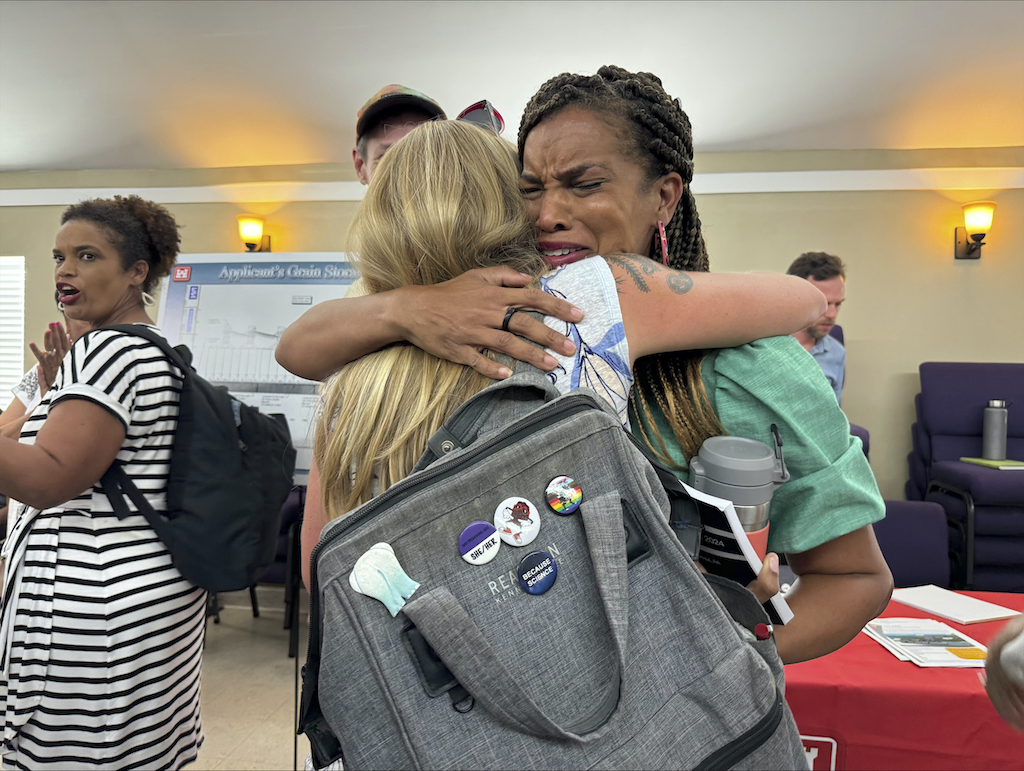
The historic Black community of Wallace, Louisiana, celebrates a win as residents have stopped the Greenfield grain export terminal. This win comes several years after many people in Wallace first started speaking out against the project—an enormous grain export complex proposed by Greenfield Louisiana LLC, which would have been built on the same grounds where some locals’ enslaved ancestors once lived. Last week, a representative of Greenfield Louisiana LLC announced during a public hearing that the company would be “ceasing all plans” to move forward.
The proposed $400 million dock and grain terminal would have been built on a 1,700-acre site purchased by Denver, Colorado-based company Greenfield Louisiana LLC, in the historic Black community of Wallace, St. John the Baptist Parish, Louisiana. With a grain elevator as tall as the Louisiana Superdome, with 54 storage silos the height of the Statue of Liberty, the Greenfield project would have caused serious environmental harm, potentially disturbed archeological remains and burial grounds, and would likely have acted as a gateway for further industrialization of the property by the oil, gas, plastics, and petrochemical industries. The Greenfield facility would have driven additional pollution and injustice in Wallace, St. John the Baptist Parish, and across the River Parishes region, which is already facing the serious impacts of unchecked industrial development in primarily Black communities, like Wallace.
The Descendants Project, a Wallace-based environmental justice organization co-founded by twins Jo and Joy Banner, has been one of the most outspoken opponents and organizers against the Greenfield project. The Descendants Project has led several years of community organizing and action against the project. This includes bringing a successful lawsuit ending an illegal re-zoning ordinance, halting a proposed resolution that would have eliminated the safety buffer requirement between “heavy industrial” and “residential” zoning areas, commissioning an impact study on how the grain terminal would impact the community of Wallace, and much more.
It’s the latest industrial project to threaten the community—and the latest that residents have successfully held off. In 1992, the Wallace community successfully rallied against the construction of a Formosa Plastics Group’s proposed rayon plant that would have displaced residents—including the Banner sisters’ family, when Jo and Joy were just 10 years old. That project was finally halted after it came to light that the parish president, Lester Millet, was guilty of extortion and other crimes as he helped Formosa move forward with its plan to build in Wallace.
For the second time in my life, I have had to fight to save my beloved home of Wallace. First from Formosa Plastics, and this time from Greenfield Louisiana. Once again grassroots efforts, combined with the support of advocates from all over the world, prevented over 130 tons of pollution, including dangerous particulate matter, from entering our community of Wallace and the whole of Cancer Alley. Today, we can proudly say that we stood on the shoulders of our ancestors to stand tall against corporate polluters and an abysmal government that allows it, for the protection of our homes and heritage. Communities, do not take ‘no’ for an answer—but instead, tell polluters the answer will always be ‘No!’
— Jo Banner, Co-Founder and Co-Director of The Descendants Project
As a result of The Descendants Project’s organizing, in April 2024, the Army Corps recognized the community of Wallace as a National Register Historic District for its association with the African American experience in Louisiana and as a postbellum African American community. Additionally, the Army Corps determined that the proposed grain terminal’s construction and operation would cause day and nighttime lighting, noise, and traffic, and that vibratory impacts would have an “adverse effect” on the Community of Wallace National Register Historic District. There is also the likely possibility that the project would have destroyed archeological remains and grave sites of enslaved peoples related to the Black descendant community, which may exist and have not yet been found on the former plantation property Greenfield planned to develop.
In the U.S., people living in predominantly low-income, rural, Black, Indigenous, People of Color, and other underserved communities and regions are more likely to die prematurely due to toxic air pollution, in addition to experiencing polluted soils and waters, and facing heightened risk of fires and deadly industrial accidents like explosions. This is the result of decades of racist policies and practices, including slavery, segregation, blockbusting, and barriers voting that enable polluting, hazardous industries to most easily become established in these communities that are least valued by society.
Sadly, many people in the descendant community across the River Parishes, including elsewhere in St. John the Baptist Parish, face health challenges caused by exposure to industrial pollution, as well as the social and economic harms caused by the legacies of slavery and other forms of racism.
The Descendants Project is helping to shift this pattern by assisting local people in finding non exploitive and safe jobs, serving as tireless advocates for the descendant community, and taking action to end environmental injustice on a systemic level, and creating spaces that are welcoming and celebratory of Black lives—including their newly acquired Woodland Plantation in La Place, Louisiana.


